|
Knight-Knave
Problems
Suppose you go for your vacation to the
Island of Knights and Knaves – will you be able to converse with the natives,
and make your way around the island? Thanks to your Logic training, the
answer is yes. Formal Logic provides all the tools you need to
handle Knights and Knaves.
Here is the basic rule of the Island of Knights and Knaves: Knights always
tell the truth, and Knaves always lie. As you might expect,
this makes communication a little complicated. Knights and Knaves look
the same, so it’s not immediately clear if a person is one or the
other. Of course, you can ask the person which he or she is – but
they’ll say “I’m a Knight” either way! (Knights will say this because
it’s true, Knaves because it’s false.) So how can you tell who is who,
and which sentences to believe? Formal Logic is the key.
For example, suppose on the beach you meet two natives of the island, named
“P” and “Q”; and P says “Either I am a knave or Q is a knight”.
The first step in sorting out such a situation is to translate the
claim into formal language. Let’s use the following translation table:
P: P is a knight
Q: Q is a knight
Now, what if we want to say that P is a knave? Do we need another
sentence letter for that sentence (maybe “R”)? NO – because on
the island of Knights and Knaves everybody is either one or the other.
So saying that P isn’t a Knight, is on the island equivalent to saying that P
is a Knave. Using our translation table, “P isn’t a Knight” would
be “~P”. And we know that this is equivalent to saying “P is a
Knave”. The same trick works if you want to say that Q is a Knave:
that’s the same as saying that Q isn’t a Knight.
P: P is a Knight
Q: Q is a Knight
~P: P is a Knave
~Q: Q is a Knave.
Now we can translate what P said into formal notation. P
said:
Either
I am a knave or Q is a knight
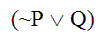
This translates as:
But what do we do with this sentence? We apply the two laws of the
Island to it.
The First Law of the island is this: if P is a knight, then what
P says really is so. And what P says is: “Either P is a Knave,
or Q is a Knight.” So, according to the First Law: if P is a Knight,
then (Either P is a Knave, or Q is a Knight). Using the same
translation table, we translate the First Law into formal notation:
The Second Law of the island is the reverse of the first law: if
what P says is true, then P is a Knight. In formal notation:
Now, both of these laws are guaranteed to be true. These two laws mean that P ↔ (~P v Q).
On the
island, Knights always tell the truth (First Law), and if someone tells the
truth, that person is a Knight (Second Law).
So, if P gives any statement S, we may write it using the if-and-only-if notation:
P ↔ S
and we get two sentences, P → S and S → P .
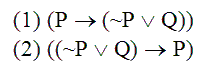
In this example, we get the following two sentences and we know that both of these sentences must be true:
With our semantic methods, we can use sentences (1) and (2) to figure out
what P and Q are. Using truth tables, we can figure out the situations where
both of these sentences are true.
It turns out that the only valuation where sentences (1) and (2) are both
true, is the first valuation.

And in the first valuation, the sentences “P” and “Q” are both true.
Remember: by our translation table, “P” means “P is a Knight,” and “Q” means “Q is a Knight”. So in a
situation making sentences (1) and (2) true, both P and Q are Knights.
But we know that in the situation we’re in here, sentences (1) and (2) must
be true. So: in this situation, P and Q are both Knights.
That’s how to solve a Knight-Knave problem.
1.
Translate what the speaker said into formal language.
2. Build two conditional ‘law-sentences’ which are guaranteed to be true:
• If the person is a Knight, then the statement that
person said is true, P → S .
• If the statement the person said is true, then that
person is a Knight, S → P .
3. Then find out where these two sentences are
true.
Alternatively, you can evaluate P ↔ S direcly in one step instead of evaluating the two sentences P → S and S → P separately.
|